This blog contains material I wrote and posted on multiply.com between the years 2005 and 2011 only. It does not contain any new material. For newer writing, please check my main blog (Bill the Butcher).


Showing posts with label capitalism. Show all posts

Wednesday, 28 November 2012

Auto-R/Eject: Metaphor For A Society

From December 2008:

I’ve been reading a bit about the collapse of the plans for a bail-out of the car industry in the US and how it’s imperative if all those poor workers aren’t going to have a terrible Christmas, and how all those people will starve, and so on, and so it’s imperative of the US government to bail out all the “Big Three” whose CEOs might otherwise have to, ulp, give up their private jets and their champagne. What a tragedy.

All right, this isn’t really my business, not being an American, but there are a few things I’d like to mention anyway, since apparently the impending implosion of the US stock market is driving down stocks across the world, and that has its own effect on the cloud-cuckoo-land of the Indian bourses - something which has absolutely nothing to do with me but might affect some dupes who put their money into the hands of stockbrokers and similar low-life scum.

The first thing is, how in sanity’s name does a nation that isn’t a banana republic (in the original meaning of the term) get itself to a position where the collapse of demand for a single product threatens the collapse of an already crumpling economic order?

Anyone who knows anything about cars will be aware that they aren’t, you know, the best things for Planet Earth’s health. Yes, we need transport, and it’s only common sense that transport should be as cheap and easily accessible, not to mention as environment-friendly, as possible. So a sane and healthy society should encourage public transport at all times, in preference to private transport. Certainly a sane and healthy society does not dismantle the public transport system in order to promote and raise (to the level of a religion, for all practical purposes) private transport.

Before I get any further, let me state my view of the car’s position as a basal unit of the American lifestyle. Since I am not American, and since I’ve never visited the US (nor am I ever likely to) my views are more likely than not to have serious flaws, but since I’ll be basing my arguments on these views anyway, I should lay them out for you.

In America, as far as I can see, one of the major rites of passage of life is the acquiring of a driving licence as soon as one is old enough to take the tests to acquire one. This is a somewhat odd thing because in most nations of the world those who need to learn to drive learn to drive. Nobody learns to drive as though it was as essential as knowing how to tie your shoelaces. Not that I’m saying nobody should learn to drive; I’m saying that this is an indicator of the basic problem.

Now, when everyone knows how to drive, there’s a market for cars (as there has been since the Henry Ford auto revolution) for them to drive. If everyone wants to buy a car, there is competition between car manufacturers to sell cars and therefore prices drop and, further, easy credit becomes available to tempt people to buy. Once prices fall to the level where every member of a family can have his or her own car (if only a used one) there is no incentive for maintaining public transport. Also, with the amounts of money they rake in, car manufacturers can buy serious political influence to downgrade or eliminate public transport so that everyone has to buy a car, like it or not, unless they want to remain confined to walking distance of their dwellings. (I shall be getting back to this point in just a bit.)

Also, once you eliminate or reduce public transport to the point where it serves only a small percentage of the population, you make sure that private transport becomes the main form of transport of the majority of the population. This seems a somewhat trite point until you realise that a population dependent on private transport becomes a captive market for that transport – and the ancillary services that feed it: tyre manufacturers, petrol stations, upholsterers, repairers, used car agents, wreckers, whatever. So if you eliminate cars you eliminate the livelihood of all those people – an immense industry that supplies the needs of a car-dependent lifestyle.

Then, again, public transport can supply the needs of communities. This is important to understand. Public transport cannot and does not – and is not intended to – reach out to each and every isolated house in the middle of the wilderness. Public transport can get you to small hamlets and villages, but will not get you up that dirt road fifty kilometres into the hills where your weekend getaway lies. A public-transport dependent society basically arranges itself around nodal points of communities – whether villages or metropolises. But when you have everyone owning a car, one can go where one wants, and such things as fifty-kilometre-away weekend getaways and houses in distant, isolated suburbs become possible. And when finance becomes available for that as well (without even proper credit checks) there is no pause to think before taking on that expense as well as the one on the car and the house in town.

Would a public-transport-dependent society have dropped itself into a sub-prime crisis? I somehow don’t think so.

Then, to proceed further: when everyone owns cars, the manufacturers come up against a problem. How do you sell a car to someone who already has one? How many cars can a man own, anyway? But once the manufacturers have set up the facilities to make cars, when the lines are rolling, you need to sell, don’t you? You need to pay the bills and your workers and still make a profit, not to mention pay off the politicians you control? So you have to make cars less durable (good old built-in obsolescence), or you have to brainwash the people into junking them after a couple of years, or both. In any case, what it means is that somehow you have to create demand in an economic space where there would normally be none. And this, naturally, means an enormous amount of wastage: of metal and rubber and leather to make cars, of advertising to sell them, of worn out parts to junk or recycle, and so on – all of which have both economic and environmental costs. The economic cost is obvious. As for the environmental cost, not even the most eco-friendly car can ever be a fraction as environment friendly as your average tram or trolleybus or even train – because it would take some thousands of cars to carry as many people as a single suburban commuter train does, and the train does not need immense road networks for it to travel on or gigantic parking lots, using immensely valuable urban space, for it to park on.

Then there is the social cost of car ownership. I may be a little bit wrong in this, but my theory is that people who travel under social conditions develop a closer relationship to each other than those who are isolated from each other by the four walls of a travelling metal box on wheels. Car ownership is basically a selfish action: it tells society: “I don’t give a damn about you. You go about your business your way. I’ll go about my business my way. Just stay clear of my space.” Social structures that encourage public transport are likely to be social structures with increased levels of interdependence and resilience in times of crisis.

Another aspect of the social costs of car ownership is the fact that you can’t – especially in towns – indefinitely expand road space. Sooner rather than later, a car owning society will so clog up the roads with cars that the entire purpose of car ownership is defeated because the average speed of travel falls to near walking pace. Once a person begins spending hours on the commute to work, everything suffers, from social interactions to family life to even shopping or reading. A car owning society becomes a society of isolated, harried individuals with extreme levels of stress – and without coping mechanisms because everyone else is in the same boat. And when you thought that was bad enough, remember that this is also a society where just about anyone can buy a gun. Wonderful.

The third aspect of the social cost of car ownership is that any society that becomes dependent on owning cars moves on to a point where – since everyone has a car – the focus moves to more expensive, larger, glitzier vehicles as a social status symbol, and of course, to earning enough to pay for that. The car ceases then to be a form of transport. It even ceases to become a luxury (which it still is in most parts of the world). It becomes a state of mind.

A fourth social cost of car ownership is the accident rate. More cars on the street means more accidents. More accidents means more deaths, injuries, litigation and insurance costs. (Last year alone, 130,000 Indians died on the roads. The comparative death toll in terror attacks? 500?)

There is another, and much deadlier, social cost of mass car ownership. This is the point at which social and economic costs meet. You see, mass use of cars means that one needs to have available the fuel to run them. This fuel is available in some quantities in the US, but will not last forever, and in any case there is not nearly enough to feed domestic needs and simultaneously maintain emergency stocks.  Most of the fuel has to be shipped in from halfway around the world – West Asia. This fuel is necessary for the society to keep running; this fuel is necessary at what are thought reasonable rates for the society to keep running. The only way to safeguard these supplies is to control the sources of those supplies – militarily by occupying them, politically by foisting pliant dictators (democracy might throw up a popular independent government, you see, so no democracy wanted) on them, and economically by paying off the elite and creating a slave underclass in them. This is something that arouses, naturally, resentment and makes for “terror attacks” as well as tensions with other nations who feel that they too have a right to the resources of the world.

Remember a word: globalisation. Most of the time it’s a dirty word for those of us on the left of the political and economic spectrum. But once in a while it does bring a sadistic, Schadenfreude-filled, grin to our faces. Like when Japanese car manufacturers, with their cheaper varieties and lower costs, come into the American market and further help to provide the glut that the car owning society inevitably finds itself suffering.

Now if there is a collapse of the economic bubble on which this entire car-owning society is based – if the easy credit on which this society is based breaks apart, for instance – suddenly there are vast numbers of people who can’t pay for their vacation houses, or their SUVs, and so on. They default on their loans. They put their houses on the market. Once they no longer have suburban houses or vacation homes they no longer need cars to get to them. Once they have no jobs, they don’t need cars to travel to those jobs. In fact, they try and sell their cars in order to stay alive. So the market gluts with used or hardly used vehicles. People aren’t making as much money as they used to, so nobody in his right mind buys a new car. In fact even the old cars don’t find adequate numbers of customers. So the manufacturers must cease production; even to get rid of the cars already produced is difficult enough. And in the meantime there is also no longer the same market for tyres and petrol and the rest of it – because people are driving less and people are even, horror of horrors, returning to what remains of the dismantled public transport system.

This isn’t the 19th Century any more and you really can’t force the rest of the world to buy American vehicles at gunpoint to take the pressure off the car manufacturers, in a sort of 21st Century Opium War. You also can’t overnight return to a public transport based society after systematically destroying it for a hundred years. Even if you could, the car-manufacturer-owned politicians won’t allow that. In any case, the car manufacturers are well aware that the fuel supplies will run out sooner rather than later and that they will have to invest major amounts of money into research and development of fuel efficient and non-polluting vehicles – something that will further reduce their profits.  

And so the car manufacturers demand that, in effect, they be paid not to produce cars, or the whole socio-economic structure will collapse, and take the ancillary services with them. And if that means that workers should be underpaid and unions defanged, that’s fine with them. The profit motive rules supreme.

This is where a car-owning society gets you.

I wish I could say that what I wrote above means the demise of the car, but it doesn’t really. In this country, the car population is still expanding, and without even the basic requirements of pollution control or even driver training. I know people who drive cars without knowing that a red light means stop and green means go. I am notjoking about this. And the greatest cause for air and noise pollution in Indian cities is the car, especially with the incredibly bad Indian fuel which makes a mockery of any clean engine technology. As for traffic congestion: when I was a schoolboy, it took just ten minutes to get to my old school by car or motor scooter – sometimes less. It took about 25 minutes if one walked. Today it still takes 25 minutes if one walks. But it takes about 45 minutes, at the least, if one wants to go by car. In the meantime, the buses that one could take have vanished. The public transport system in this city is extinct.

Things will definitely be worse when the new wave of ultra-cheap cars come into the market, led by the Tatter No-no (Tata Nano) – if they come on the market. With just a little bit of luck, they might not. Tata is under enormous economic pressure, and has suffered tremendous losses this year – mostly due to Mr Rotten Tatter’s own greed. With a little bit of luck the disaster of the private transport society may pass us by.

Certainly I hope so. But one can only hope.

Tuesday, 27 November 2012

Odd Things About Capitalists


When the stock market flies high, they don't want government interference. They want to be left alone to make their profits.
But
When the market crashes, they scream for the government to do something to halt the slide.
When they set up factories, they want the freedom to sell their products to whom they like at the rate they like.
But
When they set up their factories, they would like the government to get land at gunpoint if necessary and hand it over to them at subsidised payments, and that, too, deferred.
They scream about governments providing free or subsidised power and tax relief to farmers.
But
Wouldn't mind, in fact lobby hard, for free power and tax holidays for themselves.
They constantly praise the "efficiency" of capitalism , to wit, it allows only the fittest to survive.
But
They urge laws against the logical culmination of such an economic "survival of the fittest" strategy, the creation of monopolies like Microsoft for example.
They say capitalism will help everyone through the trickle down effect.
But
They will try and pay their workers the tiniest pittance they can get away with.
They say capitalism is inherently fairer than socialism because of its "people friendly nature".
But
They would make services "user payable", which means anyone not able to pay for something would not be able to use it. Check your bank balance before calling the private fire brigade, people! 
They promote free trade when it's they who are doing the exporting.
But
When someone else is exporting to them at a lower cost, then you see tariff barriers reach sky high.
They say socialism breeds corruption.
But
They have no problems making money from no bid contracts, warmongering, bribing politicians, and polluting and raping the environment for short term profit.
They want patent protection for their inventions and ideas.
But
When they can, they are more than happy to steal someone else's ideas for their own use.
Maybe I'm just stupid, or maybe I'm missing something, or maybe I'm a dinosaur who's out of touch with the realities of the world.
Or maybe capitalism is just plain crazy after all. 

Money for schooling and nothing for free


In most of my blog posts I write in the abstract. Seldom do I write something out of my own experience.
Back when I was a student in the institution of learning pictured above, we had what we thought was an onerous enough schedule. Those were the days where we had five and a half day school weeks, and five of those days were spent in uniform, and each day had five hours of classes and an hour’s lunch break. We’d spend ten minutes of that hour eating and the remaining fifty on the fields, playing – and there were three large fields to play on, not to mention wooded slopes where one could clamber around to one’s heart’s content.
Each year, after the final examinations were over in November, we’d contact those we knew among our seniors and buy their textbooks. Those books would be of no use to them in their new classes, and we could save sixty or seventy per cent on the cost of new textbooks. All that was fine with the school administration. They were busy running the school, scheduling classes and examinations, and so on. No one had any desire to rock a pretty stable boat.
I guess someone suddenly had a bright idea. I guess someone suddenly decided they could make a lot of money.
The first sign was when they filled in the swimming pool and built a new wing over it. More space. More classrooms. More pupils. More revenue.  
Ah.
Then – for no reason I can determine to this day – they chopped down forty huge trees that had stood for as long as anyone could remember on the slopes I mentioned. I remember the super-incompetent Brother Noronha, Catholic monk and principal (who later left the calling, and no bloody surprise either) declaiming before the assembled school, “We cut down forty trees and we planted four hundred trees, and we intend to plant four thousand trees.”  Even then I found the argument dodgy. Four thousand? Wouldn’t they, er, occupy a hell of a lot of space? Where would that space come from?
Guess what? Last I looked, not one of the alleged forty trees, after the passage of so many years, has been replaced.
Then – even as the school timing shrank to five days a week, this achieved by extending daily schedules and restricting the lunch break – they stopped giving out the sports gear which they had been lending out every afternoon to those who wanted it. No explanation given.
They shut the hostel down, because boarding students took up a lot of space and that space and money could be better used to build yet more big buildings – and, yes, more classrooms, more pupils, and etc. Naturally, the weekly evening movie went for a toss as well.
Well, I left. I went to college, then medical college. But when I came back to my hometown on holiday I’d usually take a walk over to the school to see what things were like. I came, I saw, and I couldn’t believe my eyes.
Remember those three fields I mentioned? Two are lined by wire fences, and locked gates. You couldn’t get on them if you tried.
The slopes are also sealed off. No entry, very sorry, boys. Go and play someplace else.
The third field is now an almost exact counterpart of a Second World War prisoner of war camp, with tall barbed wire fences breaking it into boxes. There is no way anyone can even get on those fields.   
This at a time when schools throughout India were desperately looking for playgrounds and trying to at least appear to be promoting some sort of sports culture.
Remember the days I spoke of, when we used to buy our seniors’ textbooks?
You can’t do that any more. In order to ensure that you can’t do that any more, they change the textbooks every year. And since there are not that many good textbooks anyway, the dross that comes in is pretty awful. Our long gone Radiant Readers and similar texts are supplanted by something written for someone with the understanding of a two year old and the attention span of a jellyfish.
Hell – you can’t even buy the books that they prescribe in the market any more. You can’t even use exercise books not sold through the school, without the school’s coat of arms on the cover, any more. You can only buy through the school’s shop, at rates the open market can only dream of charging. And meanwhile the fees have gone up by several hundred percent – naturally.
They even reduced the number of subjects by restricting the languages taught. This saved on teachers employed and salaries. Result: net earnings up.
Oh – did I mention that wearing school-supplied tracksuits is now mandatory on those days when the school gives pupils their strictly rationed quota of drill time? We had done perfectly well with our flannels and blazers. They can’t.
And what is the result of all this? Has the school’s right to make a profit on its investment paid off?
Well…
Back when I was in this school, going by results and public perception, it was among the best schools of North East India.    
Now, it is not even thought of as one of the best three schools in Shillong.
Ah well, who cares, so long as the moolah is flowing in.

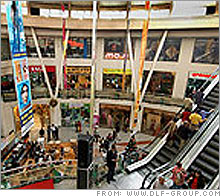
The Consultant's Report


e
    
                                        SECRET AND CONFIDENTIAL                  
To
H E Artless
Secretary, Grand Shopping Mall
Superabad
India

Sub: Marketing strategies for your new mall.

Sir,

As per your commission, my firm has conducted a study of how to pitch your mall towards maximising the returns from your target market. Appended is our detailed report for your perusal. However, in this letter, I would like the opportunity to sum up the salient points for your benefit.
First, I suggest that you must make your mall look exclusive. It’s in any case true that the mall will only cater to the rich – the upper middle and upper classes. So, it would be foolish and unproductive to throw your gates open to those who cannot buy anything and will just increase your cleaning bills and your wear and tear.
Therefore, we suggest that you restrict entry to your mall to those demonstrably capable of purchasing your merchandise. The easiest way of doing this is by making it compulsory to show one’s credit card at the entrance. Only those with credit cards should be allowed access. If it could be managed, it would be very good if you could make it compulsory for all purchases to be paid for with credit cards, but as far as I know this is probably against government regulations. Still, as we know, the current government is friendly towards progressive business interests and credit card companies could be asked to lobby hard to allow such regulations at least for malls catering to the empowered sections.
We are aware that this strategy (restricting entry to credit card holders) was tried before and did not work, because of objections from certain sections of the population and from left-wing anti-national elements it would be pointless to name. But in our opinion the failure of that brave and farsighted attempt was more due to incorrect marketing strategy than anything else.
In our opinion, the correct strategy should have been pitched differently for the targeted crowd and the general populace. While the targeted population should be reassured of its exclusiveness, to be made to feel that the mall’s throwing open its doors to them is a statement of faith in their financial security and a reward for their financial success, the rest of the people shouldn’t be made to feel excluded. The rich should be told that there is no need for them to rub shoulders with the dirty, untidy common folk, that this is theirs, a consumer’s paradise, just for them and for people like them. The rest, though, even though they may not have a hope in hell of ever being able to enter through the gates, must not be made to feel neglected. You can always claim that this is actually a good thing for the others – it gives them a goal to aspire to. If the only way to enter the portals of your shopper’s paradise is to acquire the credit cards that are your entry ticket, it makes sense for people to work hard enough and earn enough to afford credit cards. So, excluding non-card holders makes it a positive thing for the economy. It promotes long term economic growth.
We hardly need to point out that the words “economic growth” are engraved in gold on the hearts of the current government, and anything that professes to promote economic growth will resonate well with them. And since the media can be easily co-opted with the same slogan, the media will also back any such move by you. A few discreetly bribed editors should do the trick.
It may be that some unregenerate left-wing pinkos may ask the question of where the poor are supposed to shop until they can afford the credit cards they must aspire to. If they do, we suggest that you point out that a branch of Wal-Mart is supposed to open in this city at some time in the future. The poor, you may suggest, can go to the Wal.
Secondly, the importance of proper packaging can’t be overemphasized. The issue of government support must be kept in mind. This government will support anything that backs up its policies. Since the thrust of this government’s current policy is to force through the Nuclear Deal, and since the rationale is increased demand for power, you should emphasise the extremely high power consumed by malls like yours and how such drivers of the economy demand high amounts of power. The government will readily uphold you as an example of why the Nuclear Deal is necessary.
As a part of this strategy, high energy consumption is essential; please ensure large, power-intensive displays and billboards that consume the maximum amount of electricity that can be managed. Economy in electricity is not the right way to go about this. Please don’t be concerned about high electricity bills. You do not have to pay them at all, if the government is on your side. And with the strategy we are outlining, it will be.
Thirdly, we are sure you must be aware that there will be resistance from reactionary left wing elements to the mall. This must be handled in two ways. First, media sources must be paid off so as to belittle the opponents as anti-nationals and Luddites who oppose economic development. Please do not skimp the fund meant to “educate” editors and journalists. Also, please ensure low level menial jobs to local families who might otherwise join in protests against the mall. These jobs will break up the unity of the opposition, and after the mall is established the concerned individuals can be quietly dismissed. We are, naturally, assuming that you have no intention of allowing any sort of effective employees’ union to come into existence.  
Fourthly, since the Tata Group is the reigning economic power behind the current throne, we would advise you to invite Mr Ratan Tata to formally inaugurate the mall. Anything Mr Tata does is automatically news. His influence on the media is so great that even his blunders and his bending of laws and ethics double are treated as immense personal triumphs. If he either inaugurates the mall or makes a symbolic purchase, you would get immediate media attention.
Fifthly, America resonates with your targeted demographic. We would suggest you design the mall round the US as a theme, with American flags prominently displayed and US resident George W Bush’s portrait with India’s current Prime Minister on as many walls as possible. This will also garner further government support.     
With all these actions, as discussed in greater detail in the main report attached, we can be reasonably sure that you can market the mall to your target group and gain sympathetic media attention and government support at the same time.
We would, of course, draw your attention to our bill, also attached. It may seem to you high, but as per the terms of your brief we believe, not excessive. After all, you are going to fleece the population and the economy, and we don’t see why you shouldn’t pass on a fraction of that to us.

                                                                              Yours sincerely

                                                                     S. Liz Ball
                                                                     Chairperson
                                                                     Moneybags and  Associates
                                                                     Marketing Consultants.

Eekonomics

(July 2008)


e
I once read somewhere that in ancient Athens, members of the Senate (or whatever the governing council was called) who proposed new laws, would do so with a rope round their necks. If the law failed to pass, they were hanged.
I don’t know the truth of this, but I certainly think it should apply to all of today’s politicians, with the proviso that the rope should be attached to a hook attached to their intestines. But for a change I’m not talking about politicians here, except unless the roles intersect.
No, I’m talking about those all-knowing, all-pervasive, incomprehensible, experts and masters of life and death, the economists.
Show me a guy who thinks he knows everything that matters, and I’ll show you an economist.
Show me a guy who thinks people don’t matter, only figures do, and I’ll show you an economist.
Show me a guy who thinks abstract and incomprehensible theories are more important than simple common sense, and I’ll show you an economist.
Show me a guy who lives at such disconnect from the facts that he might as well be on another planet, and I’ll show you an economist.
If an economist thinks that a particular economic policy will result in the poor becoming richer, for instance, he will insist that it is happening – even if right in front of him the people are getting poorer and poorer.
I think economists should be forced to stand up in public and explain their fancy theories in words of not more than two syllables. And then I think they should be forced to provide proof, right there in public, that the theories are working. If they don’t, they should be compulsorily made to ceremoniously and literally eat their words in the form of newsprint, CDs, and any other medium in which they have appeared, before being banished to work at digging ditches for a century.
What triggered this particular rant? I have always been contemptuous of economists, as those of you who remember my comments on Swaminathan S Anklesaria Aiyar will recall, and generally I give the illiterate (in the facts of life) morons a wide berth, but today I began reading an article by one of the tribe on how to tackle rising prices. Since I’m not of the income bracket which can afford to ignore prices rising to the skies, I read the article, with my jaw hanging wider and wider open till it threatened to hit the floor.
This guy starts off with a standard enough idea: if the amount of available money in an economy increases, and the supplies of goods and services don’t keep up with the increase in available money, then larger and larger amounts of money will chase the finite supply of goods and services, so, basically, said goods/services will go to the highest bidder and all prices will shoot up. I don’t have to have ever touched an economics textbook to agree with that one.
Not that I have a great dispute with his follow-on idea either: that money that is neither regulated nor taxed, illegal money in all forms, is more easily acquired and hence more easily expended than regulated or legal money. This being one of the most corrupt countries in the world, there is an ocean of slush money out there. Fine.
So what does our economist suggest? Does he claim that the obvious solution is to try and crack down on corruption so as to cut the source of illegal money off at the roots? No. He’s much too brilliant for that.
No, what our genius suggests is worth the Nobel Prize in his discipline: he says the government should at once ban the circulation of the three highest denomination notes in circulation; the Rs 1000, Rs 500 and Rs 100 notes. According to him, this would force everyone to deposit their money in banks, where it could be taxed, or to buy tax free bonds from the government. Either way, the amount of money could be regulated.
Let’s see now. I go to the shops, let’s say, to buy a whole passel of stuff – like so many other people. Instead of carrying a few thousand and five hundred rupee notes with me I have to drag along a sack of fifty rupee notes, because the average Indian shop will – quite right too, in my none too humble opinion – refuse to accept cheques. I guess this character envisages a lot of applications for credit cards – and he may well be a vice president in some financial institution offering credit cards. But, unfortunately, the average Indian shop also doesn’t accept credit cards. And even the Great Indian Muddle Class, let alone the rural poor, neither understands nor uses credit cards. To say nothing of the recurring expenditure on them.
Brilliant, as I said.
All right now, let me help the whole thing by taking it to its logical conclusion. Since the eminent economist here wants the supply of money to be regulated, let’s regulate all, but all, money. Let’s demonetise fifty-rupee, twenty-rupee and ten-rupee notes as well, along with the coins and notes of five, two and one rupee value. Thenlet’s issue currency of denominations such as three rupees, seven rupees, nine rupees, and seventeen rupees. And see the prices drop like an express lift – as the eminent economist says should happen.
And when he wins the Nobel Prize, will he be so kind as to mention me in his acceptance speech at least?   

Schadenfreude

From October 2008:


e
A year or so ago, the Indian columnist and former Communist politician Ashok Mitra wrote of how he was at one of those TV shows so beloved of Indian channels where a hyped up anchor tries desperately to make grown men and women throw hissy fits at each other like spoiled six year old kids.

In that particular show, Mitra said, there was one of the noveau riche of the Great Indian Muddle Class, one of the many who have battened on the alleged economic miracle of the last couple of decades since we abandoned socialism. This man, who boasted of his immense shoe collection, was challenged by some of the others, who asked if he felt justified in buying so many shoes when thousands went barefoot because of the lack of wherewithal to purchase them.

Arrogantly, this man declaimed that he didn’t give a damn about anyone else. He had his money and he intended to get the full enjoyment of it, and to hell with all those who couldn’t afford what he could.

Well, that article by Mitra brought in a storm of replies – not condemning the shoe lover, as you might think, but supporting him. All those men and women, good citizens all, said that the shoe fetishist had every right to his wealth and that there was no point in thinking about anyone else. The nation, they said, could only move forward as a whole if each person worked for himself and himself alone.

And over the years, that mindset seems to have only been reinforced, with the state abandoning any semblance of even-handedness in its treatment of the populace. In simple terms, the more money you have, the better you are as a person. India’s alleged economic miracle is simply one of privatisation run riot and the common man (aam admi, in Hindi, which also translates ironically to Mango Man) being sucked dry.

Well, guess what? Nemesis strikes.

With the stock market crashing, and crashing, and crashing, nobody can expect me, at least, not to rejoice over the plight of the shoe fetishists and others who have been growing fat on unearned wealth, as I wrote about a few days ago. And nobody can expect me not to rejoice over the plight of the MBA graduates who might suddenly actually have to earn a proper living doing real work, instead of sitting back watching their overblown salaries roll in. I rather fancy some aspirants to business colleges might be having second thoughts right now. How does dentistry sound as a career?

And I’m very, very happy also because those people who owned no shares but who claimed to feel national pride at the soaring stock market indices have to go seeking a new source of pride for themselves.

I’m even happier at the response of our estimable Finance Minister, who, like our (unelected) “prime minister”, is an “eminent economist”, and who keeps telling our investors not to panic and quit. As this pair knows, because it is they who are responsible, hardly any Indians own stock. Most aren’t even aware what a stock exchange is. Almost all the stock is owned by what are called Foreign Institutional Investors, which are basically holding companies with offices in Mauritius (why Mauritius? Because – as I blogged about a year or two ago – any firm with an office in Mauritius doesn’t need to pay taxes in India). It is these unsecured investments which created the myth of India’s “soaring foreign exchange reserves” and the surging stock indices…nothing more. These firms, naturally, will pull out their investments when stocks fall. Nothing the prime and finance ministers do will have any effect on them. So I can absolutely expect the situation to get much, much worse for the money market before it gets better.

We’re witnessing the demise of the capitalist system, people. It will take a while, but bandit capitalism is done for, and the other sort will undoubtedly follow.

I used to read the reports of the demise of socialism, and I used to think those reports slightly premature.

He who laughs last laughs longest. And I’m grinning now.   

(And, no, I don’t give a damn if some greedy little idiot loses home and shirt to the stock market. The stupid berk deserves all he gets.)   

Red Star Over India?

Let’s call her Rani Koda. That name will do as well as any other. She’s young, not very pretty, not particularly intelligent or talented. She’s nobody special, no “queen” despite her name; just one of the poorest of the poor in India, one of the people so poor that the concept of a full meal twice a day is alien to them. She, Rani Koda, lives in a forest village, and has never seen a school, or a dispensary, and all she has is the small patch of ground on which her family grows a few vegetables, and the forests around in which her people have always lived and whose nature spirits they worship, and from which her people gather what they can to provide for their needs.

Now one day, a man from the government comes and tells Rani Koda that she must get off her land and go away; the government has decided that this land, and the forest, must be compulsorily taken over in the “public interest”. In order to ensure that she gets off the land, it sends in police to force her off, assuring her that she will be “compensated” and “resettled”, in time. It then says it can’t resettle her immediately because it has no land, and as for the meagre “compensation”, if it’s actually ever issued, what little is left after sundry middlemen have taken their cut wouldn’t buy her food for a week.

Oh, and what happened to her patch of land, taken from her because it is so essential to the national interest? Like the rest of the forest, it was given, virtually free of cost, to some capitalist mining corporation for stripping it of its mineral wealth. The total destruction of the local people, the forest, and the environment isn’t of any concern. Fattening the bank balances of corporate fatcats is in the national interest, it is.

Meanwhile, destitute, illiterate, stripped of all she ever had, including her nature deity, what options has Rani Koda? She could become a prostitute in the lowest class of brothel in the nearest shanty town, paying off the police and the pimps and the local hoodlums, watching her body rot from disease and the alcohol and drugs she takes to make her life bearable. She could commit suicide more directly, by setting herself on fire or drinking some poison, if she could get hold of it. Or she could protest.

If she protested “democratically”, peacefully, absolutely nothing would happen. Not even the local newspaper would even bother to take the slightest notice. At the most, Rani Koda might be considered enough of a nuisance to be dragged off to jail without a formal arrest, raped and beaten in custody, and then – if lucky – let go with no more than a warning to behave in future.

If, however, Rani Koda decides her only option is to fight back in an organised way, by taking part in mass protests and blockades, what will happen to her? Without the faintest shadow of doubt, she will be declared a dangerous left-wing terrorist, a Maoist, even if she’s never heard of the late Chairman Zedong. Police and armed paramilitary units will be deployed to break her peoples’ resistance, they will be shot down and imprisoned, and – if at all possible – carefully chosen hooligans and other malcontents from among her people will be armed and trained and formed into “people’s militias” to unleash a war of repression in order to force the people to yield. Even journalists and others – like Dr Binayak Sen, for instance – who are sympathetic to her people’s cause will be arrested and if possible locked up, if required for years, on charges so trumped up that they fail the laugh test.

Given this reality, would it perhaps be surprising if Rani Koda decided her best option was to join the Maoist “terrorists” she is anyway going to be accused of being part of? Would it be totally astounding if she thought that, since the state will in any case respond with violence, her only option to defend her life and property is to take up arms against the state? Even if she knew nothing of left-wing ideology, wouldn’t it be right to say that the state has just created a “Maoist terrorist” where there was none?

Now let’s get back to the mining corporation that wants the land. With the most Big Business-friendly government in the nation’s history in power in the country, a government so Big Business-friendly that it’s made “growth rate” into an all-purpose excuse for any action it chooses to pursue (just like the Bush regime’s invocation of “9/11” to excuse any and all of its crimes), it wants to strike while the iron is hot and make as much money as quickly as possible. And it knows some things. Knowledge is power, as they say.

It knows that the “prime minister” of the country, who is the head of government despite never having won an election in his life, is an “eminent economist” whose personal record is of spineless fealty to corporate interests. It knows that his government is full of people with organic connections to business interests, which they no longer even bother to conceal, and that they will do anything for Big Business if the money is right. It knows that the person responsible for internal security, the nation’s Home Minister, is a former corporate lawyer with a history of working for mining companies and who is an ex-board member for one such company, which has (perhaps coincidentally) been given rights to mine bauxite in forest land in Orissa state. It’s perfectly aware that in “mainstream politics” there is absolutely not a single significant voice against the policies of snatching people’s land to give over to corporate entities; even a supposed “Communist” party, the nation’s largest left-wing political group, has taken land at gunpoint from peasants to hand over to a notorious right wing corporate figure to make the “world’s cheapest car,” after all. It knows that all political parties are hopelessly beholden to capitalist concerns for election funds. It knows that the makers of the “mainstream opinion” in the nation – the print and electronic media – are utterly corrupt and amenable to bribery and outright purchase.

So, what, from its point of view, is the logical thing to do? To “manufacture opinion” by the payment of judicious bribes for an all-out war on “left extremism” (in other words, on Rani Koda and anyone else who is too poor to register on the national consciousness), and to prod the (extremely amenable) state to send in its forces to fight the war. Isn’t it deadly simple, when we consider how easy it is to “create consent” for crimes? Take a look at the Bush regime’s run-up to the Iraq invasion, for example.

So it’s not exactly a surprise that suddenly – virtually overnight, in the last few months, since the moment this ultra-business-friendly government took power, in fact – “Maoist extremism” has become Public Enemy Number One in what passes for “news” in the national media, surpassing the old bugbear, Islamic jihadist terrorism. It’s not exactly a surprise that the (unelected) “prime minister” (who has never won an election in his life, not even a fraudulent one, but has gone on record saying “The people of India deeply love you, Mr Bush”) has declared “left wing extremism” to be the country’s greatest internal security threat, much more than Hindunazi organised terror, which has repeatedly killed more innocent people in a few days than the Maoists have done in their entire existence. More honestly, he also (on June 18, 2009) told Parliament: “If left-wing extremism continues to flourish in parts which have natural resources of minerals, the climate for investment would certainly be affected”
, which may have been a Freudian slip in that it showed where his thoughts really lie.

It’s also, therefore, no surprise that this government, which claims it has no land to spare to resettle the displaced from its “development projects” but has no problems finding farmland and forests to hand over to business houses to convert into factories and “Special Economic Zones”, has decided to create a plethora of anti-Maoist forces with such names as Cobras and Greyhounds, which are, I guess, supposed to slither or race through the forests and eliminate the evil Red terrorists. It follows that the Air Force asks permission to fire on the Maoists “in self defence” (rich, indeed, since the Maoists have never, ever, attacked the Air Force). It’s no surprise that such a newspaper as Calcutta’s The Telegraph, which is all but a formal mouthpiece of the (unelected) “prime minister”, runs virtually daily front page stories from the “anti-Maoist battle zone”. And so on and on and on.

Meanwhile, in a development not entirely unrelated, the government and media have, suddenly, apparently, realised that China, that giant Maoist behemoth next door, has evil designs on the country. Anti-China rhetoric is suddenly the flavour of the season, and includes shamelessly making up stories such as the alleged shooting and wounding of Indian soldiers on the (disputed) border, which even the Indian government denied. When the nation’s Home Secretary (a bureaucrat under the Home Minister, and following his orders) declares that the Maoists are getting arms from China, you know the reason why.

So just who are those Maoists, who are suddenly such a colossal threat to the nation? I’ve already discussed them here, and that post might be of interest. In brief, they are a very, very disparate peasant guerrilla army, armed with crude bombs, landmines, bolt-action rifles and the like, who have varying levels of presence in a number of districts in various Central and South Indian states, termed by the media a “Red Corridor”. Oddly enough, this same “Red Corridor” comprises the areas where desperately poor people, who have always been neglected by the state, are being systematically exploited by rapacious corporate entities. Strange coincidence, isn’t it?

Most of the Maoists belong to a single grouping, the Communist Party of India (Maoist), which has excellent reasons for not trusting the corporate-funded so-called democratic process; and individually, their reasons for joining have much more to do with personal survival (like Rani Koda’s) than ideology. They run “people’s courts” which deal out summary justice and are therefore preferred to the official and extremely corrupt legal system, which will take, quite literally, thousands of years just to clear the backlog of cases it has currently on its hands. They provide the people among whom they live a measure of protection from moneylenders and sundry exploiters. And, of course, when the big corporations come calling, they form a potent weapon for the people to defend their rights, lands, and lives.

Is it then a surprise that for this government, they are Public Enemy Number One?

Of course, the spectre of a peasant guerrilla army, numbering, by the most extravagant estimates, 20,000, on foot and armed with shotguns and First World War vintage .303 Lee Enfield rifles, marching into Delhi and taking over the country, in the face of one of the world’s (theoretically) strongest military machines, is laughable in the extreme; the Maoists have never, for longer than a few hours, managed to take over even a small town (unless one claims that people defending their rights to their land and blockading the government’s forces are ipso facto Maoists). Sane minds would realise this, and the same (unelected, Bush-hugging) “prime minister” also declared that the Maoists have limited capabilities. So, when hysteria is deliberately raised about them, and simultaneously the state goes out of its way to accommodate business interests, one doesn’t, perhaps, have to be a super-genius to put two and two together and come up with four.

In the blog entry I’d mentioned previously, I’d discussed Maoism in India and Nepal and discussed why a people’s revolution could succeed in the latter but not in the former country. However, in that post I was talking about, specifically, organised militant Maoism, and that still will never succeed, in the conventional manner, in capturing power in this country. That still holds true. However, there is a new factor involved, and that is this government’s utter and complete barefacedwillingness to wage war on the people of this nation in the name of combating left-wing extremism. Anyone who is poor and willing to stand up for his or her rights, or anyone who supports the poor person’s right to ask for his or her rights, is now fair game as a “Maoist”. The problem is that despite the fairy tales about the nation’s spectacular economic growth, more people are poor today than ever before, and the disparity between the tiny super-rich minority and the rest of the population is growing apace, and also that the armed forces are increasingly packed with personnel who are now joining up only because they have no other avenues of earning employment.

Therefore, when the government decides to begin warring against its own people, what it is doing is unleashing an army of poverty draftees against the people from whom they spring. When you do that, sooner rather than later the distinction between attacker and victim is going to get blurred, and increasingly there are going to be crossovers and desertions to the “other side”.

Meanwhile, the corporate entities to whom the government hands over the nation will concentrate on maximising their profits; naturally, because this is what they exist to do. Social justice isn’t even on their agenda. They are there to make as much money as possible as fast as possible and quit while ahead. To do this, they can buy the government and the media and they can successfully brainwash the Great Indian Muddle Class. But they can’t get rid of the poor, and they can’t brainwash the poor.

The poor don’t care about SMS polls that celebrate the country’s “achievements”; the poor can’t put on the growth rate or eat at the “global high table” to which the nation allegedly aspires. You can throw them off the land and push them into a fringe existence in the cities; you can make them destitute and deprive them of a legitimate voice. But even if you do all that you can’t take away their anger. That anger will only grow and grow, and there will be no dam that can hold it back.

Ultimately, then, when the rapaciousness of the corporate-government complex grows clear to everyone, and there is no further place to hide, the stage is going to be set for a very messy civil war, and there won’t be any winners. In many ways, we’ve already gone too far to turn back.

It’s not the beginning of the end, but it’s the end of the beginning.  

A Different Chemical Warfare: The Bhopal Gas Tragedy

I remember the afternoon of 3 December 1984. Year-end examinations were going on at school, and I’d finished taking the morning paper and was waiting for the afternoon exam to begin. I can even remember where I was; our school’s old art class, built in the old British style and hung with abstract oil paintings in dark colours, which has long since been demolished to make way for a swank concrete eyesore where paper “craft” cutouts hang from the ceiling. 

So this is what happened. As we were all waiting for the exam to begin, we began to hear a rumour that some kind of gas had escaped from a factory in Bhopal, the capital of Madhya Pradesh state in the centre of the country, and that many people had been killed. That was a year when many things had happened, was 1984; the first, and to date only, Indian citizen in space, Rakesh Sharma, went up on a Soviet Soyuz rocket; the Golden Temple, headquarters of the Sikh religion in Amritsar, had been “liberated” from Sikh “terrorists” demanding an independent state of Khalistan, and then, a few months later, Prime Minister Indira Gandhi was murdered by two of her Sikh bodyguards in retaliation, followed by a frenzied government-sponsored anti-Sikh pogrom across India. It was a year in which so many things happened that one’s brain tended to get numbed from all the input.

Over the next few days, the newspapers and magazines and what passed for TV (only the one channel, which showed only what the government allowed it to show) overflowed with photographs of corpses; corpses lying on the streets, corpses laid out in rows on hospital lawns, corpses being buried (one famous photo was of a child’s face, sightless eyes open), corpses, corpses, everywhere.

[image]

The actual story came out in bits and pieces. A toxic gas had escaped from a factory in Bhopal (1), owned by a subsidiary of the American company Union Carbide, and had killed an unknown number of people (at the time, it seemed that Bhopal must have been depopulated, such were the reports). We were all familiar with Union Carbide, since its logo appeared on the batteries we bought for our torches and transistor radios and electric clocks. Eveready, the commonest brand, was then a Union Carbide product (2). We all wondered what kind of poison in our batteries did this, because we didn’t know what a multitentacled creature Union Carbide actually was. How could batteries kill a city?

Later, when things had settled down a little, the “official figures” (I might as well say here that official figures in India are quite properly believed by nobody since they have nothing to do with reality, especially when death tolls are concerned) spoke of some two thousand five hundred deaths, which were later expanded to four thousand. By then, though, independent sources were already talking of upwards of fifteen thousand dead, and uncounted more (today, there are five hundred thousand registered survivors of the gas leak, and the number of deaths is over twenty thousand) affected, in many cases for life.

What was the “toxic gas” responsible for this?

Back then, hardly anyone had heard of methyl isocyanate, MIC as it came to be known to one and all. MIC was a chemical used in the manufacture of pesticides sold under the brand names Sevin and Temic, which were also (surprise!) manufactured by Union Carbide. Union Carbide had initially imported the MIC from factories in the US, but had begun manufacturing it, right there on the spot, instead, and stored it in giant underground concrete tanks.

[image]

Now MIC isn’t exactly the safest of chemicals. It’s prone to corrode containers, and in contact with air it breaks down to a mixture of gases including carbon monoxide and hydrogen cyanide. It is also extremely volatile and in bulk it has to be stored at a temperature below 15 degrees Celsius and preferably at zero degrees, and at above atmospheric pressure. In fact, (vide Union Carbide’s own brochure,Methyl Isocyanate, July 1976) it is not recommended to be stored in bulk; the normal practice is to store it in sealed steel drums, and not to manufacture it in larger quantities than needed (3). For the amount of pesticides actually produced by the plant at Bhopal, the amount of gas needed was between three and four tons. Yet, as attested by former employees at the plant, from June 1984, upwards of ninety tons was being stored in the tanks, and of those, no less than forty two tons were in Tank No 610. And to top it all, the tank’s contents were under atmospheric pressure and at atmospheric temperature, the refrigeration facilities having been shut off as part of a cost cutting exercise.(4)

Why was so much of this highly toxic gas manufactured and stored in these underground tanks, so much in excess of requirements? An obvious answer is that since it was a highly toxic gas, manufacture had been removed from the home territory of the US and shifted to an expendable “Third World” nation where lives were cheap. And though there were safer alternatives, they were more expensive, and therefore would cut into profits.

To get back to the point: there was this highly toxic gas stored in a tank without refrigeration and without the high pressurisation that would stop contaminants from entering from outside. There were also few or no safety mechanisms installed and most of those were not working properly. No evacuation plans existed, and the local administration had not been informed as to the contents of the tanks and what the toxic effects might be in case of a leak.

Sounds like a mess? I’m just getting started.

It wasn’t as though there hadn’t been prior leaks from the plant; employees had died previously and the leak had actually been predicted fairly accurately by a local journalist, but nobody had been interested. Now, on the night of 2 December, all the things that went wrong were about to come together.

First of all, what happened was the entry of some 500 litres of water from an installation called the Vent Gas Scrubber (meant to neutralise leaking gas) into Tank No 610. This caused an immediate exothermic reaction with tremendous increase in heat, to over 200 degrees Celsius. This increase in temperature went unnoticed because the temperature recording devices were out of order and had not been repaired. (4)

What happened after that can be told. The entire tank burst out of its underground confines and began leaking gas in tremendous quantities, starting at approximately five minutes past midnight and continuing for about 45 minutes. The gas could not be burned off because the systems to do so were (quite predictably) inoperative. Wind carried the gas over the entire locality, which was crammed with slum clusters filled with poor people.

It’s not easy to remain unemotional about what happened next. Starting awake (remember it was past midnight) with burning eyes and lungs, their breath turning to fire in their throats, people stumbled in the darkness trying to flee the enemy they couldn’t see, as liable to run towards a concentration of gas as away from it. Thousands collapsed and died on the streets and in the Bhopal railway station, one of the sites affected (among the dead was the elder son of an engineer killed in a leak three years earlier). The drifting gas was blown over much of the city before finally dispersing; and in its wake it left dead and hurting, everywhere. It’s been estimated that three-fourths of the then 800,000 people living in the city were affected to some degree. (5)

One of the many problems rescuers faced was that they had no idea at the time what the gas was, or what it was capable of. Doctors weren’t told what antidotes could be administered, so treatment was basically symptomatic and – with the hospitals swamped – often inadequate. 

Four days after the incident, on 7 December, Union Carbide CEO Warren Anderson flew into Bhopal along with other executives, and was arrested for culpable homicide not amounting to murder. His arrest lasted all of six hours, after which he was hurriedly granted “bail” on the orders of “someone in a high position” (more anon on this) and was flown out by special plane from Bhopal airport to New Delhi. According to the pilots, senior Madhya Pradesh police officers saluted Anderson at the airport and even offered to carry his luggage (6). He flew back to the US the same day...and, officially, has been “untraceable’ ever since.

Meanwhile, as time passed, more and more people continued to succumb to the effects of the gas (5) around the now closed and sealed factory. Chemicals continued to leach into the ground and contaminate water supplies (and continue to contaminate water supplies to this day). Cases were lodged against Union Carbide demanding compensation to the tune of $3 billion for the victims. Union Carbide responded by alleging that it was either a pure and simple accident and so not their fault, or, apparently not recognising the contradiction, that it was all due to sabotage by a disgruntled employee. The judicial authorities in Bhopal froze the 50.9% of the shares Union Carbide held in its Indian subsidiary, but the Supreme Court of India not only allowed the subsequent sale of those shares but diluted the liability of Union Carbide from $3 billion to just 15% of that amount – a paltry $470 million, and absolved Union Carbide of all responsibility for the accident (though that was later revoked after protests). The Supreme Court judge hearing the case, Justice Ahmadi, became, after retirement, chairman-for-life of a Union Carbide trust (3). Something rotten in the state of Denmark, perhaps?

Even the meagre compensation that was to be paid under the new terms was mostly not paid. The worst of Indian officialdom rapidly raised its ugly head. Centres to train survivors in alternate professions either never functioned or functioned only briefly and shut down. Those who were to get compensated for the deaths of relatives didn’t just have to produce death certificates; in order to prove that the certificates weren’t faked, they were supposed to produce the people who had been at the funeral, and so on. I told you this was Indian officialdom. (7)

Meanwhile, what happened to the criminal charges? After a long delay, charges of culpable homicide (causing death by actions performed while knowing they were capable of causing death, while not actually intending to cause death) were brought against eight Indian employees of Union Carbide, and of Union Carbide’s Indian subsidiary; and against Warren Anderson, Union Carbide Corporation, and Union Carbide’s Hong Kong based subsidiary which was the direct owner of the Indian subsidiary. Of these, the three foreign entities (Anderson, the parent Union Carbide, and the Hong Kong subsidiary) refused to appear before Indian courts – and for the others the charges were reduced from culpable homicide, for which the maximum punishment is ten years, to causing death from negligence, carrying a maximum sentence of just two years. (3,8) 

In the meantime, something else happened. Union Carbide was bought by Dow Chemicals in 2001 (9); and Dow promptly disclaimed all responsibility for the Bhopal disaster, saying, in effect, that if you knowingly buy stolen property, it’s yours no matter what the original owner might think. This same Dow Chemicals is now eager to invest in India, and the extremely pro-US/pro-big business Congress government of India is bending over backwards to find a way of letting it do so.

On 7 July, 2010, the verdict in this case, at the lowest level of the judicial system, was finally declared (after only 26 years – these are Indian courts, my friends); the seven survivors of the eight Indians were sentenced to two years each, and then released on bail with full freedom to appeal. It caused a surprising degree of outrage among people who had virtually forgotten Bhopal; an outrage that can only be understood as a reaction against the government’s policies per se, of which this was only a symptom.

What policies were those?

According to popular perception and also according to those in the know, the government does not actually want any real punishment to come to the criminals of Bhopal. It’s scared that any such punishment will scare off big business investments, as will enforcing corporate accountability; so it did not pursue the case vigorously and also diluted the case against the accused as far as possible. Dow doesn’t even have to pay for cleaning up the old factory site any longer; a government committee’s decided that Indian firms will be asked to bid for that at Indian government expense (10). “Bending over backwards” may be a term too weak to fit.

Union Carbide’s then CEO, Warren Anderson had reputedly vanished and is allegedly untraceable, though Greenpeace found him (11) with little or no effort and informed the Indian authorities as to his precise whereabouts. He is still wanted in India for culpable homicide, and despite all government efforts to let him off the hook, the case against him still stands. Remember that he was allowed to escape by special plane in 1984? Well, today, the buck is being passed around (10) over who, exactly, ordered his escape. The Chief Minister of Madhya Pradesh at the time was Arjun Singh, a cravenly obsequious functionary of the Congress’ ruling Gandhi family. He would – could – never have taken a step without orders from Delhi, and in fact he does admit having such orders, though he refuses to state who issued him those orders. Every single objective person’s suspicions then come to the then owner of the Congress Party, the then Prime Minister, Rajiv Gandhi. Gandhi’s widow and children are now the owners of the party, and their only priority is to deflect blame from the family. Hence, desperate efforts are on to find scapegoats; efforts that have to take into account as well the need to protect Anderson at all costs. He’s untraceable, they insist; he’s too old; there’s no proof against him; and, when all fails, “he can still be extradited to face trial.” When? 

It’s not just the fate of Anderson or of foreign corporations; the fact is that the government is desperate to please the US at all costs, and its only (alleged) foreign policy success was the Nuclear Deal it signed with the Bush administration to sell nuclear reactors to India. The US won’t sell nuclear reactors unless the government passes laws to insulate the sellers against all liability for accidents. So far, despite two efforts, it has been unable to pass this law, and the renewed public interest in Bhopal may make it more difficult still.

One of the (unelected) “Prime Minister” of India’s recent statements, then, shows everyone exactly what the government’s actual attitude is: “Bhopals may happen,” he said, “but the country must progress.”

Tell that to the gassed corpses lying on the streets.

[image]

Sources:

1. http://en.wikipedia.org/wiki/Bhopal_disaster
2. http://en.wikipedia.org/wiki/Energizer_Holdings
3. http://www.frontlineonnet.com/stories/20100702271301000.htm
4. http://www.frontlineonnet.com/stories/20100702271300400.htm
5. http://www.frontlineonnet.com/stories/20100702271302000.htm
6. http://www.asianwindow.com/environment/how-warren-anderson-escaped-from-india/
7. http://www.frontlineonnet.com/stories/20100702271302500.htm
8. http://www.frontlineonnet.com/stories/20100702271301300.htm
9.http://en.wikipedia.org/wiki/Dow_Chemical_Company#Union_Carbide_merger
10. http://www.frontlineonnet.com/stories/20100702271301600.htm
11. http://www.greenpeace.org/international/en/news/features/carbide-criminal-found/


Note: There is a book by Dominique Lapierre and Javier Moro on the subject, It Was Five Past Midnight in Bhopal. I have read the book but chosen not to quote from it because I find it little better than pulp fiction. It provides no sources, has no references, and apparently takes every participant’s unsupported word for the truth. Significantly, at least one of its heroes, SI Qureishi, was one of the men sentenced recently to two years for criminal negligence.