This blog contains material I wrote and posted on multiply.com between the years 2005 and 2011 only. It does not contain any new material. For newer writing, please check my main blog (Bill the Butcher).


Showing posts with label philosophy. Show all posts

Wednesday, 28 November 2012

On The Nature Of Freedom


A long time ago, when the dinosaurs ruled the swamps and I was a teenager and formulating my outlook on life, I used to keep coming across this phrase, the “free world”, in the media and in books (there was, of course, no Internet then; we’re talking about the Mesozoic Era, don’t forget). The “Free World”, of course, was the Western capitalist democratic model, and anyone who did not belong to it was automatically part of the non-free world.

Even then, it sounded to me a bit odd.

After all, these champions of the Free World were the same people who were aiding and abetting the apartheid regime in South Africa, which was anything but free, and supporting any number of spectacularly nasty dictatorships in South America, Africa, and Asia. These champions of the Free World were also the people who stood by as the government of West Pakistan massacred three million East Pakistanis in 1971 – and I’m not even mentioning the Zionazi regime and its actions in Occupied Palestine, or the American championing of those fighters for freedom – the bearded and turbaned Mujahideen in Afghanistan who would go on to spawn the Taliban and inspire a goodly portion of global jihad.

There seemed to be something a bit wrong with the term “Free World”. In general, it revolved around the word “free”.

In recent days, in fact, I’ve been reading a lot of discussions online about the meaning of freedom, so it chimes in neatly with my own thoughts on the subject.

So what is this creature called “freedom,” anyway?

Is it freedom on the personal level: the ability to do exactly as one wishes? Or freedom on a  social level: the ability of a society to function without restrictions? Or is it economic freedom: the laissez faire policy? What about political freedom: democracy? And if it is one or more of these, just where does that get us?

Back in those days again, when dinosaurs walked the swamps, etc, the civics textbook we had in school told us that there was no such thing as absolute freedom, and illustrated the point with the example of a man who was pulled up in court on charges of having punched another man on the nose. The man claimed he had a right to swing his fist. The judge informed him that the right to swing his fist “ends where the other man’s nose begins.” This might seem basic – the idea that there is no such thing as absolute freedom; but if you have ever taken part in any of these online discussions, you’ll know that “absolute freedom” is a concept that keeps being bandied about.

Much of the discussion, in fact, is circular logic – the idea that such and such a nation is a free country only because it’s declared itself to be a free country, therefore there’s no need for further discussion. So-and-so country is a free country, and anyone who dares say otherwise is an enemy of freedom.

Setting aside the arguments of such people, or the juvenile efforts by the gentlemen and ladies who in 2003 decided to rename French fries “Freedom fries” (I wonder how many of them cringe at the memory today?), it might just be worthwhile to take a look at freedom and what it means to us.

First, freedom on a personal level. I may be just a tad wrong on this, but it seems to me just possible that a modern functioning society can’t function very well if each individual does exactly as he wishes (or as his conscience tells him to). Hell, I can’t imagine a Neolithic village functioning if each individual does exactly as he wishes to. I can’t even imagine a Robinson Crusoe character doing exactly as he wants to. Just imagine some guy on an island. Can he do exactly what he wants? Obviously not. His freedoms are restricted by his environment, on his need for shelter, food, a source of water, safety from predators, and so on. What freedom is there? None.

As a further expansion of this idea, complete freedom will mean that Mr X is completely free to knock Mr Y over the head with a club (or shoot him with a Colt revolver) if he has a minor disagreement with the latter, say, over who should have access to a woman or a job or a parking space or whatever. You’ll note that I mean that Mr X must be free to do this without any fear of official consequences (as he has complete freedom); though of course Mr Y (or his friends and relatives) have the same complete freedom to knock Mr X over the head in retaliation.

Can any society survive like this?

(As an insert here; some Islamic nations do allow a version of this: the relatives of a murdered person are allowed to pardon the murderer or execute him, as per their own wishes. Strange that these nations aren’t generally considered free, hmm? Even as some burqa clad ladies say the veil gives them freedom from the tyranny of having to primp for the male gaze? OK, I'm being facetious here!)

I suppose you could make a case for freedom as the only basis for an expanding nation with a frontier to expand and a wilderness to conquer, though even there “rugged individualism” will have to give way to co-operation in order to survive. And co-operation brings with it its own rules; and rules, of course are directly restrictive of freedom.

Therefore, on any meaningful basis, absolute individual freedom is meaningless. It only has meaning within limits and placed in a social context, which leads to the next point: the social aspects of freedom.

I’m an Asian. My cultural context, therefore, is Asian; and Asian societies (like African) have always tended to submerge the individual in the larger context of the society. Many things that would normally be considered “freedom” in the West, for example the theoretical freedom to sleep with whom you want when you want, as long as the other person is of right mind, is not an option open to Asians, even if they have the legal right to do so. Asian cultures are highly society-intensive, with unspoken limits on a very large part of behaviour, because the individual is expected to conform. Of course, things are changing, but slowly, and most of the change is bitterly opposed and done in secret until a certain critical mass is reached. But still and all, overall the Asian society is a far more freedom-restricting one than the European (for the purposes of this post I’ll include Australia and New Zealand in Europe – for convenience’s sake).

But is that always a bad thing? The original Asian society was still one where there was a deep safety net for stress, and where co-operation was always promoted over “individualism” – and all the great civilisations of antiquity arose in Asia and Africa, long before the rise of Greece and Rome, which had their own severe restrictions on freedom. You can’t get away from that.

In fact, you can’t even get away from the fact that until the end of the Second World War, even European nations had very little in the way of individual freedom, can you? What freedom did a Junker’s son from Prussia have, or a peon from Andalusia? How about the Cockney kid who would leave school at fourteen to become a costermonger’s assistant? Anyone? 

Free speech? It sounds very nice to say such and such a country allows free speech – until you check the reality. Just compare the amount of coverage given to pro-war voices in the American media in 2003 to the coverage given to sane people, and you’ll see what I mean. Free speech is basically a fiction. In some respects it has to be. You can’t have one section of the population calling for wholesale extermination of another section of the population in the name of free speech. If you do, you’re promoting fascism, which isn’t free at all.

Let me go back to the beginning of this piece and what I said about the “free world”. Back then, another thing struck me as a mite odd: the idea that freedom can be measured in material possessions.

I once knew a Latvian guy on Orkut whose anti-Soviet tirades were both bizarre and entertaining. One of his arguments, if one can call them that, was that blacks in South Africa during apartheid times had more cars than citizens of the USSR did. Ergo, blacks in South Africa had more freedom than Soviet citizens did.

Excuse me while I laugh. Even if I accepted the argument about the car ownership (I couldn’t because he provided no numbers, of course), how do you measure freedom in terms of car ownership? If a populace had access to cheap and convenient public transport, why on earth would it want cars?

Similarly, it seemed to me to be a bit odd that a nation that provided cradle-to-grave social care could be held to be less free than a nation where those who couldn’t measure up to the rat race might end up in soup kitchens and sleeping under bridges. This feeling was more or less confirmed when I watched the aftermath of the disintegration of the USSR, where under the benevolent and free (American-certified!) leadership of Boris Yeltsin, Russians, free of the yoke of communism, suddenly began freezing to death in doorways and starving in the alleys. Somehow, it strikes me that this is not freedom.

Also, if one means economic freedom, total freedom can only mean a completely laissez faire policy with no supervision or control of economic activity, where each entrepreneur can do precisely as he wishes, break as many laws as he wishes, exploit as many workers as he wishes, all in the name of profit. Classic bandit capitalism, in other words. Unfortunately for the proponents of this economic model, this can only end in one thing – the complete swallowing of inefficient or less efficient or merely more ethical concerns by others which can afford to undercut or otherwise destroy the competition, so the inevitable end result is monopoly by one organisation in each sector – which, of course, isn’t freedom at all.

Let me illustrate what I mean (in case anyone has missed the point). Let’s say there are four firms, A, B, C and D, that make clocks, all of roughly the same size. The system allows complete economic freedom. Company A follows strict ethical models and pays all workers a fair wage. Company B does the same but also follows environmental norms. Company C is a concern that tries to squeeze profit by ignoring the environment and also fires workers without notice, and Company D follows no rules at all, pays workers slave wages, dumps poisons in the rivers and air, and cuts every corner imaginable.

Obviously, all other factors being equal, Company B will soon fold because its production costs will be greater than the others. The market now divided between three concerns means A will then be squeezed out because C and D can sell their products cheaper. If it comes down to C and D, D will ultimately win, since it’s got the least overheads and can make the biggest profits and so can also undercut C. So, in the end, D rules the market single handed and can do damn well as it wishes, including chucking all concept of quality control out of the window. Where is the freedom here?

Therefore, and the point is reinforced by recent economic history (think Meltdown), there can be no absolute economic freedom, either.

So how about political freedom? I’ll stick my neck out a little bit here and say that if you don’t have food, shelter and clothing enough to go around, political freedom – the freedom to vote for your leaders – doesn’t mean a load of manure. In fact, I’ll go so far as to say that such a freedom will be misused and twisted to make sure that there is not enough food, shelter and clothing to go around, so that the people who aspire to lead you can do so on the premise that there will be, if you vote for them, enough food, shelter and clothing to go around. Maybe I’m cynical. But that’s the reality of non-European/North American democracy as I see it, and I’m not quite sure about the North American component of that either.

No absolute freedom, ergo, in any of its components; but look around you. Bound by job and family and mortgages and represented by people who don’t give a damn about you after you’ve voted for them, how many can claim they have any freedom at all?

I think I’ll take the non-Free World, thank you very much.  

Tuesday, 27 November 2012

The Egg and Chicken Question


Am I sick of philosophy?
Does the sun rise?
Is the Pope a Catholic?
Friends, humans, people of the world, lend me your ears. I come to inform you, not to praise them. The evil that philosophers do lives after them; the good is always bunt to ashes with their bones. So let it be with this question.
If you really, really want something to be warped, twisted out of shape, and destroyed, get a philosopher. They say a politician is the ultimate means of turning a simple question convoluted. I tell you - a politico, no matter how dedicated to that effort, can't hold a candle to a philosopher.
Let's take solipsism. I actually thought up this nifty philosophy as a joke as a teenager, where I claimed that nothing existed except what I imagined, so that the world, this computer, my body, everything would be just a figment of my imagination and would disappear the moment my attention would turn away from it (so why the fuck am I a sexually frustrated unknown approaching middle age, huh?) . Imagine my surprise when I discovered this had actually been advanced as a serious philosophy. Well, live and learn. I guess one should (to quote my friend Caio Abramo) beat a Solipsist unconscious and then remove one of his legs, letting him explain away the amputation occurring while his consciousness was rendered inoperative.
Now, again, the chicken and egg question. Everytime I hear  anyone call something achicken and egg problem I want to scream. Trust philosophy to make a helpless confusion out of something so simple. Even though the problem can be scientifically solved, as here described,  it does not even need that. Common sense would solve it, if one just applies a little reasoning. A chicken is a multicellular organism, right? An egg is a single cell. Multicellular organisms developed from unicellular organisms. The chicken, as a multicellular organism, was preceded by the egg at every stage of its evolutionary history. QED.

Sunday, 25 November 2012

Fifteen Minutes


Let’s picture a hypothetical situation.
Imagine you are a soldier of a country under attack. You did not choose to serve in the army; you were called up, impressed into service, like it or not.

Now imagine that your country is being overrun by the enemy, blown away by a storm of steel and high explosive against which none of the striving of your army or your allies has availed anything.

All right so far?

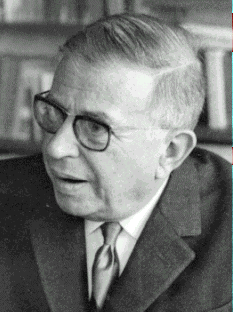
I have just been re-reading the Roads To Freedom trilogy of Jean Paul Sartre (the man in the photo, in spectacles). This is not meant as a review of the trilogy – frankly, I don’t feel myself equal to that task. All I can say about these three books is that they are an account of France at peace and war, France in the late thirties and in defeat in 1940, as seen through the eyes of a small number of characters.

Of them the most important by far is Mathieu Delarue, by no means a hero, a man who conspires in the first part of the trilogy (The Age of Reason) to try and force an abortion on his pregnant girlfriend. In the second part (The Reprieve) he is just one of the many characters who hope to find a way out of going to war, in the days of Munich, September 1938, which ended with the British and French handing over Sudetenland Czechoslovakia to Germany. And in the third (and by far the best) part of the trilogy, Iron In The Soul,  war – the war from which they had got a reprieve in 1938 – comes round, in all its destruction and defeat, and confronts each individual with the choices he must make.

Mathieu Delarue – teacher of Philosophy in school, no political leanings, conscript and telephonist in a second line unit; Boris, child of émigré Russian parents, determined to die in the war so he will not have to grow old; his much older lover Lola, singer in a cabaret; Brunet, warrant officer in the French army, Marxist; these are just a few of the human characters who populate Sartre’s pages. Most of the stories are open ended. One does not know what happens to Gomez, former general in the Spanish Civil War, trying to find a job in America; his wife Sarah, trapped on the road among refugees as the Germans storm through France, as are Mathieu’s brother Jacques and his wife Odette; Boris, who decides to try and get to England rather than marry Lola and settle down to domesticity; his sister Ivich, who got herself pregnant as an act of revenge against her own family, and now hates her husband so much she hopes he will be killed; Phillippe, stepson of a French general, army deserter and potential suicide; Marcelle, Mathieu’s former girlfriend, who mysteriously vanishes after the second part of the trilogy; and her husband Daniel, closet homosexual and mental sadist, who rejoices as Paris falls to the Nazi jackboots. Sartre, deliberately, leaves these people with the choices they make.

Only two of the major characters’ stories have some kind of closure: Brunet, and Mathieu Delarue.

So. You are this conscript. You are this conscript in a unit which has never faced any combat, part of the staff of a headquarters which has fallen back constantly as the army retreats in defeat and disorder. Then, as the government falls apart, your national capital is captured by the enemy, your president sues for peace, and your unit is threatened by the advancing enemy, your officers abandon you and leave you to your own devices. What do you do then?

This is what Sartre, himself a fighter in the French Resistance (that is, a terrorist, by  the logic of Bushist rhetoric in Iraq) says happened to Mathieu. His fellow soldiers collapsed in confusion and drink, without orders, sinking into an apathy so great they did not even attempt to melt away into the countryside and try and find their way to somewhere with hope. He watched their degeneration, not being able to take part in it, and detested by them for his “aloofness”. A fellow soldier, Pinette, a clerk in the same headquarters unit, desires to have at least one crack at the enemy. Mathieu is not enthusiastic; he tells Pinette that it would be just throwing away his life for nothing. While morale totally collapses, the last remnants of a fighting unit, comprising soldiers (like the exhausted poilu with his head resting on his hands in the photo above) retreat into the village where Mathieu and his companions are stationed, and the officer in charge – a lieutenant – decides to make a last, suicidal stand there. Pinette – ignoring the pleas of his amour, a postmistress – decides to volunteer to join the lieutenant’s troops. Mathieu, trying still to dissuade him despite his own conviction that he has no right to stop him, watches as Pinette selects a rifle from a pile. And then, suddenly, he stoops down and picks one up himself.

What is the result of this choice? Mathieu could have remained with his own unit; apart from Pinette, the rest were just waiting for the Germans to arrive and had no desire to fight, preferring to drown themselves in alcohol and wait for the end of the war after which (they were sure) they would be allowed to go home to their families. Mathieu could have joined them in the building where they were confined by the lieutenant so they would not get in the way during the coming battle. He could have maintained his contempt for them, and his distance, and waited it out. Instead, he – whether on impulse or a deep-seated decision arrived at earlier and only now made conscious – picked up a gun to join in a battle whose end was foreordained and which could only result in his death.

Let me make a digression here: in 2003, during the invasion of Iraq, I kept reading accounts of Iraqi soldiers who would fight desperately, sometimes charging American armoured columns with no more than AK47s and grenades. I remember the admiring comment of an American soldier: “They aren’t scared. Isn’t that something? They are not scared.” Of course the official American story was that these Iraqis were fanatical “terrorists”, leading to a caustic comment from one British commentator: “In my day this was called heroism, but then what do I know?” It was not evident then, of course, that Iraq would become a graveyard of the American imperium. Most Iraqi troops, believing that resistance was useless, had just quietly gone home (with their weapons) while the government fell apart. But even so, Iraqis who must have thought their country doomed to defeat chose to fight to certain death.

It is just as the Japanese who chose to fight till the end even as their country crumbled to defeat, individual soldiers sometimes taking on brigades and divisions; or the Germans who were still fighting on the eighth of May, 1945, after knowing that their government had already signed the capitulation. In each case, the definitive factor is the choice of the individual to go on fighting despite the knowledge (or belief) that the effort is futile in the long run (compared to the fighting of those who still think their side will win, despite their individual sacrifices, like the Soviet soldiers who held on to the last man in 1941-42).

Calling these mean and women “dead-enders” is missing the point. It comes down to a simple personal choice; what is one’s view of oneself in relation to the world? Is one of the view that one must, in order to find mental peace, sacrifice oneself to some ideal, or is it that one would rather stay alive for the sake of nation or society or personal ambition or whatever? Is death when it comes to be courted in order to bring oneself the peace of having done one’s conception of duty? For surely no duty forced Mathieu to fight. It was not his unit that was fighting; his unit had never fought and were locked up indoors to await the Germans and be taken prisoner. It was the choice of an individual. Purely personal.

To get back to Sartre’s story: Mathieu and Pinette, with three other soldiers, were stationed on top of the church tower to provide covering fire to the other troops. After the lieutenant had ordered the civilian population of the village to leave (Pinette ignoring the pleas of his girl, who just that afternoon had lost her virginity to him, to come down to her) Mathieu and his group had known that they were on the tower for good. If they came down, they would be fired on by their own side. So they sat up top and slept in turns while they waited for the Germans to turn up, the other three (combat veteran all) saying Mathieu and Pinette must be insane to join in a battle when they could have sat it out.
What of Brunet, in the meantime? Brunet had been part of a fighting unit; as all his men fell (and despite the usual impression that the French put up no fight against the invading Boches in 1940, as many as 92,000 French soldiers died fighting) he retreated till he could retreat no more. Exhausted, hungry, and unable to go farther, he stumbled into a cellar in the same village where – unknown to him – his old friend Mathieu had taken up position in the church tower to fight to the last. In the cellar he found a French civilian family which ordered him to get out because – they said – the Germans would kill them all if they found him there. Brunet ignored their bluster and went to sleep.

Meanwhile…

As dawn broke, Mathieu woke to find the Germans cautiously probing their way into the village. A pair of motorcyclists made the first reconnaissance, and they were allowed to withdraw in good order so as to tempt the Germans into the killing ground. When the German columns came in, the ambush was sprung and fighting erupted.

Up on top of the church tower, Mathieu and Pinette had been given the task of lookouts. Mathieu saw and shot dead German soldiers trying to sneak up on the other French positions:

He fired. The man gave a funny little jerk and fell on his stomach, throwing his arms forward like someone learning to swim. Mathieu found the sight amusing. He fired again, and the poor wretch took two or three strokes, dropping his grenade which rolled on the roadway without exploding. He lay quite still, inoffensive, grotesque, smashed. “I’ve put paid to him,” said Mathieu in a low voice: “I’ve cooked his goose.” He looked at the dead man, and thought: “They’re just like everyone else.”

It was in fact Mathieu, the man who joined in the battle on the impulse of a moment, who fought and fought well; Pinette, who had wanted at all costs to fight, cracked up as the fighting began and achieved nothing at all.

As the initial shooting slackened, and German corpses littered the road, Mathieu thought they were doing pretty well and had held out a long time. He was astonished when one of the other men there pointed out that just three minutes had elapsed since the motorcycles had passed.

Mathieu’s excited mood suddenly collapsed…for years he had tried, in vain, to act…his intended actions had been stolen from him. But no one had stolen this! He had pressed a trigger, and, for once, something had happened, something definite…He looked with satisfaction at his dead man…his handiwork, something to mark his passage on earth. A longing came to him to do some more killing. It was fun, it was easy.        

Shades of Cho Seung Hui there? Cho made his choices too…

Of course Mathieu’s actions achieved nothing. The Germans made their way to the other buildings, threw grenades inside, and killed all the other resisters. Even the soldiers of Mathieu’s unit, who had been kept locked up so they would be safe while waiting for the Germans to take them prisoner, were grenaded and some were killed where they were. Their decision not to fight did not save them.  

And then the Germans turned their attentions to the men in the church tower. They brought up an artillery piece and began shelling.

The gun fired two shots in rapid succession. They heard a dull shock above their heads, and a shower of plaster rained down on them from the ceiling. Chasseriau took out his watch.
“Twelve minutes.”
“Not too bad, twelve minutes,” said Chasseriau. “Not at all too bad!”

One by one, the shells begin to strike home. Chasseriau is killed.  

Mathieu, seeing him fall, felt no emotion. This was no more than the beginning of his own death.

The tower begins to fall in on them.

He was still firing when the roof fell on top of him. A beam struck him on the head. He dropped his rifle and fell. Fifteen minutes! – He thought in a fury, I’d give anything just to hold on for fifteen minutes! The butt of a rifle was jutting from a pile of splintered wood and broken tiles. He seized it….Mathieu was alone.
“Christ!” he said out loud. “No one shall say we didn’t hold on for fifteen minutes!”
He made his way to the parapet and stood there firing. This was revenge on a big scale. Each one of his shots avenged some ancient scruple…This for the books I never dared to write, this for the journeys I never made…He fired, and the tables of the Law crashed around him – Thou shalt love thy neighbour as thyself – bang!...Thou shalt not kill – bang!...He fired: he looked at his watch: fourteen minutes and thirty seconds. Nothing more to ask of Fate now except one half-minute…He fired. He was cleansed. He was all- powerful. He was free.
Fifteen minutes.    

So, that was all a man’s life came down to – the imperative to hold on for fifteen minutes, only to prove something to oneself (because obviously Mathieu’s fifteen minutes would mean nothing to the Germans). Nothing more, nothing less. It is obviously entirely personal; the result of the decisions a man or woman makes writes out the course of his or her life.

Who can say whether he or she is wrong?

Brunet emerges from his cellar just in time to be taken prisoner and watches as the church tower, Mathieu and all, finally collapses under bombardment. He joins one of the prisoner columns as in the third of the pictures above. His motive is not survival, as such; he sees, now, that dying is not the best way to serve his cause, and among the prisoners who gladly gave themselves up, secure in the fantasy that they would be released in a month or two, he looks for other communists and for those who can be “salvaged” by being taught about ideology and communism. Mostly, he looks in vain. But till the last, as the prisoners are on a train to PoW camps in Germany, he does not give up. It’s a different sort of determination.

And who can say whether Brunet is wrong?

The other prisoners gave up in order to survive a lost war and find a new life in a post conflict world, where they would be needed to reconstruct what the war destroyed, and to go back to their families.

Who can say that they are wrong?

Sartre was an existentialist as well as a Marxist. His idea is that one makes one’s own choices and finds one’s own path in life from the choices one makes; we are all locked in the search for our own fifteen minutes.  

Somewhere I had said that one’s life and death are one’s private property, and that one ought to have the right to choose the manner of one’s death. And the manner of one’s death is one’s own business. Its meaning is most important to oneself. What others think of it is of no importance whatever, when you come down to it.

Only the individual can appreciate his or her own fifteen minutes.      

In Search Of A Personal Philosophy


I still readPeanuts reruns sometimes.  
All right, now thatconfession is out of the way, and you’ve stopped sniggering, the reason I’m admitting it isLucy and the new “philosophies of life” she used to expound every few strips. I was trying to formulate some kind of philosophy of my own, to evolve some idea of what I might distil out of the accumulated experience of three and a half decades on this planet. It’s amazing how difficult I found it.
What is a personal philosophy? How can one formulate one and stick to it at all times, under all circumstances? Is such a thing possible? I do feel stealing is not something I should do, for example; but if I were starving and without succour by traditional means, would I take the opportunity to steal enough for myself? Like a shot. Anyone would. Except maybe a suicidal masochist looking for sainthood.
Therefore, I do not think there is any way one can have a fixed, immutable, personal philosophy.
Yet, since I feel one owes it to oneself to formulate some kind of code one should at least try to live by, if only to distinguish oneself from totally unscrupulous opportunists, here goes, remembering of course that I have never formally studied philosophy and I don’t know any of the jargon:
In the first place, of course, I’m an atheist. Although this is not inborn in me (I was a semi-believer in some sort of divinity till my early teens, though never the deity of dogma) I began to grow out of it when I began applying a little thought to it. The final break came at the funeral of a relative when I asked why all the prayers for the repose of his “soul” were necessary if he, as they said, was in heaven because of all the good deeds he’d done on earth. The lack of a coherent answer was enough.
The fact of my atheism, of course, means I do not believe in any life after death or any such charming eccentricity and anyone predicting I’ll end up sizzling in hell will draw a polite bored yawn (assuming I’m not in a combative mood. If I am, however,…well, then…) from me. Also, this means that since anything and everything I do, so far as it affects me, is bound within the unguessable span of my own limited lifetime. The usual criticism of atheists by theists is of course that atheists are “immoral” because we don’t have fear of the hereafter. This view is not something I intend to discuss in this post, because once I get on my antitheist soapbox I find it difficult to climb off; but I have yet to find atheists who are quite as immoral as the most outspoken theists, and I’ll leave it at that.
To get back to the point: if I’m an atheist, it means to me that I alone am responsible for my actions, and there is no higher deity to pull me out of messes I create and make it all right. So it is up to me to make sure that I don’t create a lot of grief for myself, for other people and the world at large, human and non-human. I don’t see that that’s worse than theistic belief.
Furthermore, I’m a pacifist. This does not mean I am a believer in non-violence at all times. It’s just that I think that n most circumstances, non-violent methods get more done, and better, than applied violence. But when all someone is willing to listen to is the language of violence, that is the medium of communication that would get through to them. Fascists don’t understand palaver.
So far as I can, I try and believe in science. It clarifies things a lot. Just as an example: since this planet is due to be cremated in about five thousand million years when the sun becomes a red giant, is there any real point donning uniforms and killing people in the name of enforcing “inviolable national frontiers”?
Then, I guess in one dimension I might be called a contrarian. Certainly, if everyone around me espouses one set of beliefs, I’m naturally going to at least look at the other side. It’s just the way I am. I think any reasonably intelligent person ought to be expected to do the same. If you insist – without looking – that the sky is green, I might at least want to see if it is some other colour. If no one had been a contrarian, we’d still have been living in caves.
My political orientation is of course – I have never made any attempt to conceal my views – left wing. I don’t believe in trickle down effects or the inherent superiority of the rich and powerful. Nothing new about that; even Jesus Christ, assuming he existed, was far left wing, like virtually all religious founders. Their followers are unworthy of them.
Well, I never claimed I could be a Lucy. I can’t live by rigid philosophies. But for what it’s worth, there are my views.
And, no, I am no solipsist (even though I flirted with it back in my teens). You are not a figment of my imagination.
Even if you wish I were a figment of yours.

Random Stream of Consciousness Garbage


There are so many things I would say to you, if only I had a voice.

So many things I would write if only I had the words.

Here I drift, grey ghost,  my physical body useless

                       trapped in time and place
                              
                                 bound by hours and days

                                       tied hand and foot by convention

                                                    hobbled by routine.

My "me" is my spirit, and  my spirit drifts through eternity

                                                                                     dumb


unable so much as to turn a page

So much for all the high thinking.

But think, all the same.

For each of us, the book of life begins with a blank page. Not even the author, whoever he is - "god" or the person himself or herself - can put a name to that page.

That comes several chapters later, and is the duty of the parents

Whose only contribution is to donate

                                                           two sets of genes.

Why do we spend so much effort over sex?

Is an orgasm worth all the heartbreak

All the bloodshed orgasms have caused over the years, the agony and the fury?

What is a neuromuscular spasm worth

                                        any more than a sneeze

                                                    when you come down to it? What?


Why are we so fascinated by death?

Why do we lie awake at night (well, I do) trying in vain to imagine the fact of death, to accept the inevitability of the fact that we are going to die? And why the hell do we make a big production out of it?

It's all whistling past the graveyard

Denying to ourselves that we just do not know what comes beyond is all right, apparently. Even the knowledge that we are denying to ourselves is fine.

What isn't fine is acknowledging

that in all probability

NOTHING comes afterwards

                                          that death comes as

                                                  THE END

Dead as Mackerel


e
This isn’t a post about whether life exists after death.

Repeat – this is not a post discussing life after death. I am NOT asking you to debate whether anything survives after we die.

I hope that’s quite clear?

All right, so what is it about?

I’ve been reading that whatever our personal thoughts on the presence or absence of a hereafter, we can’t actually imagine life ending at death. We have, somewhere in our subconscious minds, the idea hard-wired that something must survive death.

Well, OK. Maybe that’s true for some people.

Personally, though (and I spend a good deal of time, especially lying awake late at night) thinking about death – and it’s an experience I’d recommend for creating mental clarity, if you don’t fall asleep – I have no problems with the idea of my own mortality. I happen to believe that since the mind is a function of the totality of electric charges and hormonal surges affecting the brain, once those end, I end. But since I expect my demise will still be some time off in the future, it’s not something of immediate moment to me.

But...

I come from a culture which, like all Eastern cultures, places a great deal of importance on the veneration of the deceased ancestor. Most Indians are taught from childhood that the dead grandfather or uncle or whoever is looking at them from the sky and one has to talk to them, pray to them, and so on. I know of Indians who have no religious belief but are completely unable to shake off this childhood indoctrination.

In my case, two people from my immediate family – my grandmother, who served as my de facto mother while I was growing up, and my father – died literally in my arms, in the course of just five days short of a year. This is a somewhat traumatic experience, if you want to know how it felt. Since I gave them both mouth-to-mouth and CPR, all the way to the hospital, I should have been (I thought) able to save them, and for a long time afterwards I was still struggling with the idea that I – in not saving them – killed them.

In such circumstances, it would have been a nice comfortable feeling if I told myself they weren’t really dead, that they were somewhere, still existing. Only thing is – I could not, and I can not, to this day, believe that.

I do not feel the need to imagine they are somewhere "up there" watching over me and I don't think it affects my memories of them in any way. I think they are permanently dead, and when I remember them, I remember them as they were. I have no problems thinking along those lines. No.

As far as my own life is concerned, I'm quite happy with the concept of being dead. It also saves me from the fear of being judged in an afterlife.

Belief in death is liberation – you see.

Ignorance isn't Bliss


Or, is it better to be poor and knowledgeable or an illiterate billionaire?

I’m sure you all must have come across these characters who love to jeer at anything approaching the search for knowledge for its own sake. I’ve been told that anyone doing pure research is “jobless” and their efforts are useless because nobody can make money out of it.

Back in the days when I still used to go on chat, in a Bombay chat room (and you haven’t even begun to plumb the depths of deliberate and wilful ignorance till you interact with Bombayites) I was informed, by someone, who also authoritatively pronounced that Saddam Hussein was a Pakistani, that nobody needs to know history and that he was proud never to have studied a word on the subject.

Proud.

I’m sure you know where I stand on this particular question. I’ve met plenty of rich, or ultra-rich, people who wouldn’t be able to state whether the earth revolves round the sun or vice-versa, but who can afford vacations in Hawaii or London. The owner of the building where I have my clinic is a pretty good example of one (in his defence, he at least doesn’t make a virtue of his ignorance on virtually any topic not involving money). I’ve met – hell, I have people in my extended family – people who hardly have enough funds to make ends meet, but who can tell you the mathematics of black holes.

I’m sure you know which side of the debate I stand on, and by the very fact that you’re online on a site like Multiply where you generally need to spend a bit of time thinking, unlike some, I’m sure you’re on the same side of the fence.

Still, it would be nice if we lived back in the days where governments gave grants to scholars so they could do their search for knowledge without worrying where the next meal was coming from.

But until then, all power to those who dig out dinosaur bones and study the radiation from the stars.

You are the past, the future, and all that will ever be.

Reincarnation


I'm just climbing out of one of my phases of acute depression (some of you are aware of my problem) and my thoughts are tending in philosophical directions for the moment. I promise you that this introspective interlude will be temporary. It damn' well had better be.

Anyway, 'twas a remark by someone else on a different post on my blog which set off this train of thought. So the blame for this post should go not to me, but to jaymal666.

That train of thought was headed for a topic some of us could take seriously, others not: reincarnation. (Obviously believers of the Abrahamic religions, with the belief system of eternal heaven or eternal hell, aren’t concerned with this.)

Now, I've always believed that if we’re to discuss something rationally, we need to have, if only in our own minds, a working definition of what we’re talking about. So what does reincarnation mean? As far as I can see, one can call it one of two things:

First, one can posit that death is only a step in a cycle, and that the consciousness, or “spirit” if it be so called, is an entity independent of the corporeal body, and is blessed (or condemned, depending on one’s point of view) to be born, live, and die only to be reborn in turn. This process can be assumed to either repeat itself endlessly, or to be escapable if one achieves the appropriate “spiritual level,” the Buddhist state of “moksha” (freedom from rebirth) being a case in point.

Or, second, one can take a rather different view, to which I’ll allude in a moment.

Now, to discuss the metaphysical notion that death is a step in a process: I, as anyone who knows me will be aware, do not have any belief in spirituality or religion. Nor do I subscribe to the idea that consciousness has any independent existence from the corporeal body, which is a mass of chemicals and electrical charges. And I believe that the available scientific evidence, as apart from that drawn from anecdotes, tends to back me up on this point.

The brain is an incredibly complex organ; but it's still only an organ, as much one as a kidney or a lung, and as prone to failure as a kidney or a lung. Recently I was privileged to watch a video where a neuroanatomist was discussing the roles the two hemispheres of the brain played, and how they were as different as though they were two completely separate brains, performing parallel functions, and how the “personality” is a function of the fusion of the processing powers of these two parallel brains. This same lady discussed in detail her own symptoms when she had a stroke that impaired the function of her left brain, and left her incapable of reading or speaking, and yet feeling sensations that she had never felt when she had full control over her faculties. The evidence is impossible to ignore: we are our brains; and by a logical extension, when our brains die, so do our ‘consciousnesses’. I will leave aside the question of whether we have a ‘spirit’ independent of our consciousnesses as not germane to the discussion.

Also, the earth itself had an origin, and will one day be baked to a cinder when the sun swells to a red giant. Life on this planet began, in forms simpler than a bacterium, and will end one day. So, unless one posits that we are to be reincarnated in the form of protobacteria or viroids in the primal sludge of some planet in the Andromeda galaxy, I submit that the notion of reincarnation in the spiritual or religious sense is not tenable.

But, if we set aside the metaphysical version of reincarnation, we’re left with something else, and far more interesting.

Once part of it’s easy: the fact that when we die, our bodies are broken down by microbes and maggots (or rather more quickly by the action of fire) and the elements returned to nature, to be reused and recycled. That’s reincarnation, even if only as part of the protoplasm of a bot-fly or vulture. But there’s a far greater kind of reincarnation than that.

As most of us know, the stars aren’t forever; they are born, grow old, and die. And when they die, the material they throw off sometimes condenses into other stars, and planets. We can even see this process happening in galactic dust clouds. The Sun is a star that was formed from the debris of other stars, and the planets were formed quite similarly. Ergo, you can’t get away from it: we are the material of stars. Once upon a time, the matter that makes up your body, and of mine, was part of a star. And, it’s more than likely that, when the earth is a cremated rock spinning round the Sun’s burned-out corpse, we will once again form part of a new star.

Can you imagine a more awesome reincarnation? 

Why we don't exist


Today was one of those days.

Everyone has once of those days sometimes; one when you suddenly have an attack of the jamais vu; those times when you suddenly feel that something familiar and well-known was completely different from what it had ever been.

In my case, I was looking at my right hand, at the veins and the little hairs on the back, when I suddenly realised something:

My hand does not exist. Not in the way I see it. My hand is, and by extension I am, basically empty space.

Imagine the shock of this realisation. Not that I didn’t, intellectually, know it already, what with my chemistry teachers’ ceaseless efforts to hammer atomic structure into my thick head all through my formative years. Yes, I knew it. But did I know it? Did I actually say, “Here I am, a collection of a few billion infinitesimally tiny elemental particles and mostly empty space, through which cosmic rays are sleeting every moment of every day”? Did I look down at my body and think of it, not as skin and connective tissue, bone and blood and nerves, but as empty space?

No.

But today, I had that kind of epiphany.

I don’t exist. You don’t exist. Nothing really exists…except quantum-level particles doing their thing. My brain, which thinks this, is empty space, thereby proving my old teacher Kevin D’Castro right. My hands, which type this statement, are empty space. This computer is empty space.


How can I prove I exist?

I can tell myself, normally, that I occupy space, and no other material object can occupy the same space at the same time. I can say this to myself, but clearly this is rubbish, since I am empty space occupying empty space, and this space isn’t in any case really empty, but full of radiations which zoom through me as though I’m not even there. Which, in a very real sense, I am not.

What exists, then? Neutron stars? Degenerate matter? Black holes? Is the only real existence when things are squeezed into conditions which the normal universe doesn’t tolerate? Then what is normal, what’s abnormal? Is everything we see abnormal, then, and “normal” means something we can never experience directly? If I stood on the surface of a neutron star, the tidal forces would rip me into an infinity of salami slices and then smoosh me into a film wrapped over the surface of the body…but then my material would probably be more “real” than what I am now. No?

You see where this thing is taking me?

The problem is I can’t unsee it now. I have stared into the abyss, and the abyss didn’t deign to stare back.

I’m too unreal for that courtesy, and so are you.

Comforting thought? Sleep well.

On Evil


A few days ago, I was taking part in a discussion on serial killers, when the name of Ed Gein came up. For those of you who aren’t familiar with this person, here’s a potted biography:

Ed Gein was an American murderer and – to use the word in the original form – ghoul who was arrested in 1957 for killing at least two women and robbing graves for fresh female corpses, whose skin he was using to try and make himself a woman suit. At his arrest, his house was found to contain numerous female body parts fashioned into, among other things, a lampshade, a belt, bowls and masks. Anyone who really wants to can get a full inventory here.

Now Gein wasn’t actually a serial killer (though he is commonly supposed to be one), since his known victims added up only to two; and the discussion I was engaged in was on serial killers. But one of the other participants said, in paraphrased terms, that she couldn’t see how Gein was any less evil than a serial killer due to the nature of his crimes.

That comment opened up a train of thought, and in this article, I intend to see how far that train takes me.

Let’s start off at the idea of the serial killer, generally considered to be a psychopath or sociopath. Largely due to the influence of Hollywood slasher flicks, these words have pretty much become synonymous with “evil”. But what’s a psycho/sociopath, anyway? Primarily the term denotes people who lack the moral compass that generally keeps the rest of us from harming our fellow beings. A psychopath or sociopath is, comparatively speaking, like a person born with a congenitally missing finger; he or she lacks something in her make-up, call it a conscience or empathy or whatever you want. He or she is literally incapable of understanding or caring about the pain and suffering of other people, even when he or she’s the one doing the inflicting of pain and suffering.

Such a person is dangerous, granted – maybe even extremely dangerous. But, realistically, can you call him or her evil? Is a man born congenitally blind evil?

We can compare the psychological status of the psycho/sociopath with a much less rare category of human being: soldiers. As we all know, part of the job of soldiers is to “make the other son of a bitch die for his country.” But, as militaries have long known, it’s actually extremely difficult for a normal human being to consciously, in the absence of the adrenaline rush of self-defence, to kill another human being, especially so if said human being is from the same broad ethnic group as the prospective killer himself.

Militaries and militias around the world solve this problem in one of two ways. If they can, they use children as soldiers, because children (among other things) have far less than fully developed brains and lack a moral sense; they’ll shoot and hack and stab without being able to comprehend the meaning of their actions, just because they are ordered to. Or else, they set out to create psychopaths out of normal people. And, yes, they know how to do it.

And that’s why you have those films of sadistic drill sergeants terrorising new recruits. That’s why a large part of basic training comprises brutalisation and mindless obedience to orders; so that the soldier feels himself part of a machine, and loses the “humanity” that would prevent him from shooting another human he has never seen before and who merely happens to be wearing a different coloured uniform. That’s why soldiers are made to hack and chop at dummies of human beings until they can be trusted to hack and chop at real human beings.

In other words, much of basic training is geared to producing artificial psycho/sociopathic personalities. And is it a surprise that so many of them, in later life, go off the rails? Is it so surprising that so many spree killers, like John Allen Muhammad (the Beltway Sniper) or Charles Whitman, were ex-soldiers? Once you make a psychopath out of a normal person, can you depend on that person ever becoming normal again?

Accordingly, I’ll stick my neck out and say that you can call a serial killersick, deranged, insane, a danger to the community, or whatever else you want, but you can’t call him evil, unless you pretty much include anything that doesn’t conform to your view of what’s right as “evil.”

And right there’s the big danger. Once you begin classifying things as “evil”, you’re on a slippery slope of Manichean black and white where pretty much everything is black. Remember the Axis of Evil rhetoric? Ultimately, none of those states were particularly evil, any more than any other, and the only one of them to be “de-evilised” seems to have become rather more evil from any objective viewpoint.

And then there’s the other problem with calling things evil. A blanket word of this nature is meant to arouse a visceral reaction. Once you call something evil, you’re automatically saying that the factors that create the said person or situation aren’t open to discussion. Call Hitler evil, for example, and you don’t have to consider the factors that went into creating him, such as historical European anti-Jewish sentiment, the First World War, Versailles, or the cynical war reparations which caused mega-inflation in Germany. Call Hitler evil, and he can be considered to be something like the smallpox virus, to be stamped out and destroyed, and you don’t have to be worried about how your own actions are capable of producing a new Hitler. That’s the power a word like “evil” can have.

Then, of course, evil is all in the perception. If you want to believe in evil, you can find it pretty much in anything. Just like the Loch Ness Monster, where wind on the waves or a rolling log, to the true believer, can be nothing but Nessie coming up for a look, anything, if looked at in the right way, is evil. Just the other day I was discussing the niqab, which is inherently “evil” according to a lot of people. But in the middle of a sandstorm, what would you have a woman wear? A bikini? The Inquisition killed a lot of people for heresy. Just about anything could be called a heresy, if looked at in the right way. Again, the “evil” was just in the eye of the beholder. Like beauty.

Religious evil? I’m not religious, and I have no religious belief. But even the concept of sin has mutated so much over generations and cultures that just about everything you can name is, or was, somewhere, somewhen, “evil.” You can bet on it.

So, yes, I do believe that “evil” in itself is an evil word. There is no evil, in practical terms, though there are many bad things. Those bad things are bad in their own ways, and have to be countered according to the circumstances. But there is no blanket, catch all term for them.

To repeat: there is no evil.

Except I.